
Experienced real estate agents do not need another brokerage promising basic training, generic marketing templates, and a recognizable logo. They need a business model that protects their income, supports their growth, and gives them greater control over the career they have already built.
Choosing the best real estate brokerage for experienced agents requires looking beyond the advertised commission split. The right brokerage should help you increase your total profitability, strengthen your personal brand, close transactions efficiently, access reliable support, and create opportunities to build long-term wealth.
The real estate industry includes traditional commission-split brokerages, flat-fee companies, franchise organizations, independent firms, and 100% commission models. The National Association of REALTORS® recognizes traditional, flat-fee, à la carte, and 100% commission structures as different brokerage business models.
This guide explains what experienced agents should evaluate before making a move in 2026.
Signs You Have Outgrown Your Current Brokerage
Your brokerage may have been a good fit at the beginning of your career. However, the support and structure that helped you get started may no longer match the business you operate today.
Here are several signs that it may be time to consider a change.
You Are Giving Up Too Much of Your Commission
A percentage-based split can become increasingly expensive as your production grows.
An agent closing a small number of transactions may view a 70/30 or 80/20 split as reasonable in exchange for training and support. For an experienced producer generating significant annual gross commission income, the same split can represent a substantial cost.
The question is no longer simply, “What percentage do I keep?”
The better question is:
What am I receiving in exchange for the percentage I give away?
When the value of the brokerage’s services no longer justifies its share of your production, the model may be limiting your profitability.
You Rarely Use the Services You Pay For
Many agents continue paying for office space, introductory training, general coaching, lead programs, technology packages, or franchise resources they no longer use.
Experienced agents often have their own:
- Lead sources
- Referral network
- Marketing strategy
- Transaction processes
- Preferred vendors
- Personal brand
- Client database
When you are independently generating business but still paying for services designed primarily for newer agents, your brokerage costs may no longer reflect your needs.
Your Brokerage Limits Your Brand
Experienced agents should be able to build a recognizable personal brand, team, or real estate business.
You may have outgrown your brokerage when:
- Your brokerage branding must dominate every marketing asset.
- You have limited control over your website or advertising.
- You cannot build a team under your own identity.
- The company restricts how you market your services.
- Your database remains tied to systems you do not control.
Your brokerage should strengthen your reputation—not compete with it.
Support Is Slow When You Actually Need It
Experienced agents may not need constant supervision, but they still need fast access to knowledgeable support during complicated transactions.
A broker who responds only during limited office hours may create unnecessary risk when a contract issue, compliance question, negotiation challenge, or closing problem requires an immediate answer.
Strong support is not measured by the number of training videos inside a portal. It is measured by how quickly the right person responds when a real transaction is on the line.
Your Brokerage Does Not Support Your Long-Term Goals
Selling more properties may increase your income, but income alone does not automatically create wealth.
Experienced agents often begin thinking about:
- Building an investment portfolio
- Purchasing rental properties
- Completing renovation projects
- Developing a team
- Creating referral income
- Moving into commercial real estate
- Building a business that can operate without them
An experienced real estate brokerage should understand that a productive agent may want more than another sales award.
Questions to Ask Before Switching Brokerages
Before you switch real estate broker affiliations, request a complete explanation of the company’s compensation, services, technology, policies, and support structure.
Do not rely only on a recruiting presentation. Ask for the brokerage agreement, fee schedule, independent contractor agreement, policy manual, and technology terms in writing.
1. How Is the Brokerage Compensated?
Ask whether the brokerage earns money through:
- A percentage commission split
- Monthly fees
- Annual membership fees
- Transaction fees
- Franchise fees
- Technology fees
- Revenue sharing
- Administrative charges
- A combination of these costs
A brokerage may advertise a high commission percentage while charging several additional fees.
2. Is There a Commission Cap?
A capped model may allow agents to keep more income after paying a defined amount to the brokerage. However, agents should verify:
- Which payments count toward the cap
- Whether transaction fees continue after reaching it
- Whether the cap resets annually
- Whether team members have separate caps
- Whether the cap changes based on production
Never assume that “capped” means “fee-free.”
3. Which Services Are Included?
Request a detailed list of included and optional services.
Ask specifically about:
- Broker support
- Contract review
- Transaction coordination
- Compliance assistance
- CRM access
- Website or landing pages
- Lead generation
- Marketing materials
- Training
- Errors and omissions insurance
- Team-building support
- Commercial or investment education
The goal is to identify which tools improve your business and which merely make the recruiting package appear larger.
4. Who Owns the Database and Marketing Assets?
Confirm that you can retain or export your contacts, transaction history, website content, marketing materials, and CRM data if you leave.
Your database is one of your most valuable business assets. It should not become inaccessible because you changed brokerages.
5. How Quickly Can I Reach a Broker?
Ask who will answer contract, compliance, and transaction questions. Find out whether support is available after traditional business hours and how urgent matters are escalated.
6. Can I Build My Own Team and Brand?
An experienced agent may eventually want to recruit agents, create a team, open new markets, or develop an independent brand.
Ask whether the brokerage supports those goals and whether additional fees, production requirements, or restrictions apply.
7. What Happens to My Active Transactions?
Before switching, confirm how your listings, pending transactions, commissions, leads, and client relationships will be handled.
Rules vary by brokerage agreement and jurisdiction. Review the transition with both your current and prospective broker before announcing the move.
Commission Split vs. Total Profitability
Many agents begin their brokerage comparison by asking which company offers the highest split. That is important, but the advertised percentage does not tell the entire financial story.
A better calculation is:
Gross commission income
- brokerage split
- transaction fees
- monthly and annual fees
- technology costs
- insurance and compliance charges
- required marketing expenses
- =actual brokerage-related profitability
The best commission split brokerage is not necessarily the company with the most attractive percentage on a recruiting graphic. It is the brokerage that allows you to retain the greatest amount of income while still providing the services you genuinely need.
Traditional Commission-Split Model
Under a traditional model, the brokerage retains a percentage of every commission. This model may provide extensive training, offices, brand recognition, leads, management, and administrative resources.
It can work well when the value received is greater than the commission surrendered.
However, the cost automatically increases as the agent produces more. A percentage that seemed manageable earlier in your career may become one of your largest annual business expenses.
Capped Commission Model
A capped model limits how much an agent pays through the split during a defined period.
This can offer better predictability, but agents should still account for:
- Transaction fees after reaching the cap
- Franchise or royalty charges
- Monthly fees
- Team fees
- Technology subscriptions
- Annual resets
Flat-Fee or 100% Commission Model
A 100% commission brokerage generally allows the agent to retain the commission while paying a defined transaction, monthly, or annual fee. NAR’s 2025 Residential Franchise Report describes traditional split, revenue-share, and flat-fee transaction models as distinct approaches within the industry.
This structure can be especially attractive to established agents who generate their own leads and want predictable brokerage expenses.
However, “100% commission” should never be evaluated in isolation. Agents must still review every transaction, administrative, insurance, technology, membership, compliance, and cancellation fee.
Hidden Brokerage Fees to Review
Small recurring charges can significantly reduce the value of an otherwise attractive commission plan.
Request a complete written fee schedule and look for the following expenses.
Transaction and Administrative Fees
Determine whether a charge applies to every sale, lease, referral, personal transaction, team transaction, or canceled contract.
Monthly and Annual Membership Fees
Calculate these expenses across the entire year, including slower production periods.
Errors and Omissions Insurance
Confirm whether E&O insurance is included, charged per transaction, billed annually, or subject to a deductible.
Technology Fees
Some brokerages charge separately for CRM software, websites, lead platforms, transaction management systems, email accounts, digital signatures, or training portals.
Franchise and Royalty Fees
These fees may be charged in addition to the standard commission split and may not always count toward a cap.
Marketing and Compliance Charges
Review fees for signs, business cards, listing materials, photography, document review, commission processing, onboarding, licensing transfers, and account termination.
Minimum Production Requirements
Some companies charge additional fees when agents do not meet a transaction or production minimum.
A transparent brokerage should be willing to explain the complete cost of affiliation before you sign.
Technology and Support: Look Beyond the Software List
Technology matters, but more software does not automatically create a better brokerage.
The most useful brokerage technology should help you:
- Organize leads and contacts
- Follow up consistently
- Manage transactions
- Market listings
- Track business performance
- Reduce repetitive administrative work
- Protect your client database
- Work efficiently from any location
NAR’s annual Member Profile specifically examines agents’ use of technology, office affiliations, compensation, income, expenses, and firm types, demonstrating how closely technology and brokerage structure are connected to an agent’s business.
Before joining, ask for a demonstration of the actual systems agents use. Find out whether the tools are included, optional, discounted, required, or owned by a third party.
Support Should Match Your Experience
New agents may need foundational scripts and step-by-step instruction. Experienced agents are more likely to need:
- Fast contract guidance
- Complex transaction support
- Compliance assistance
- Team-development advice
- Investment knowledge
- Commercial resources
- Advanced marketing support
- Broker accessibility
The right brokerage should respect your independence without leaving you unsupported.
Investment Opportunities and Long-Term Wealth
Commission income is valuable, but it is active income. It generally depends on the agent continuing to prospect, negotiate, manage clients, and close transactions.
Experienced agents are uniquely positioned to identify investment opportunities because they understand local markets, pricing, negotiation, property condition, and transaction structure.
A brokerage with an investor-focused culture may help agents explore:
- Long-term rental properties
- Fix-and-flip opportunities
- The BRRRR strategy
- Commercial investments
- Partnerships
- Development opportunities
- Referral and team income
- Real estate ownership as a long-term wealth strategy
Investment education should be practical and delivered by people with real-world experience. Agents should also understand that every investment carries risk and should conduct independent financial, legal, tax, and property due diligence.
The best brokerage relationship should help you keep more of your current income while expanding what you can do with it.
How NB Elite Realty Compares
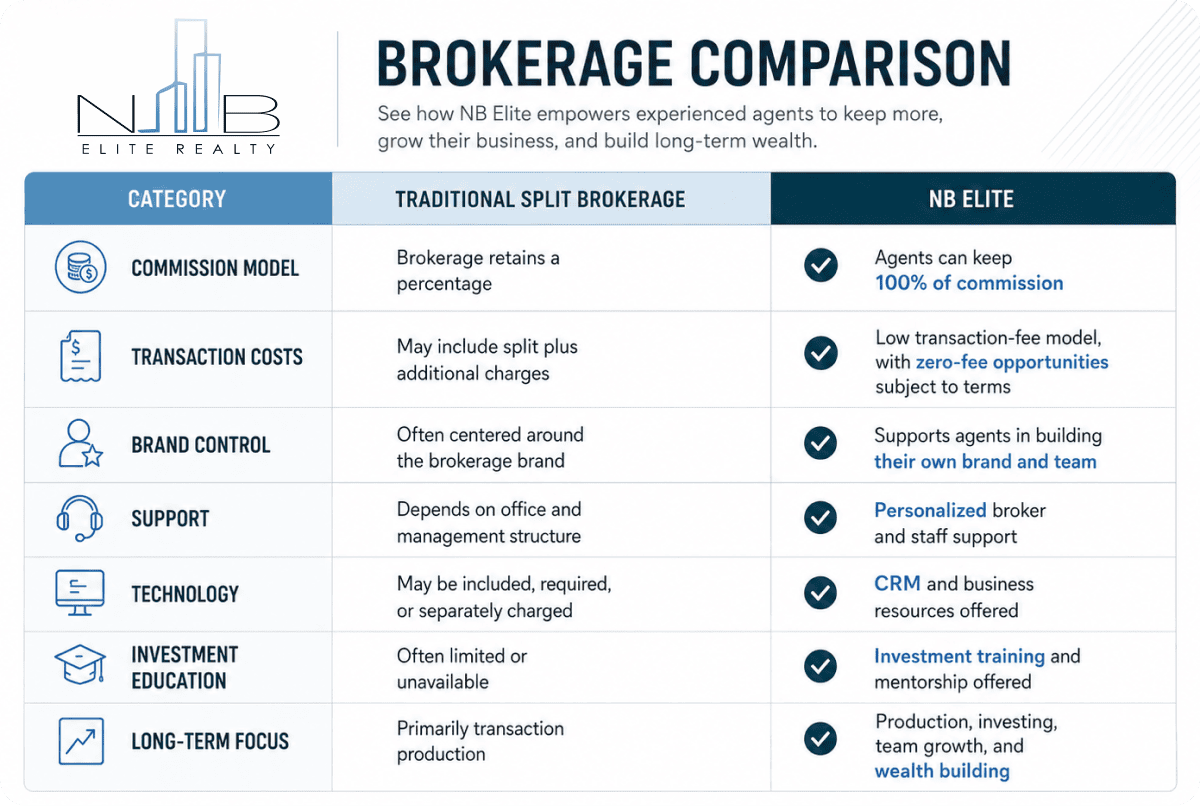
NB Elite Realty is built for experienced agents who want a low-cost brokerage model, greater control over their earnings, strong support, and opportunities to build wealth through real estate.
Its current agent offering includes:
- A 100% commission model with low transaction fees
- Zero-transaction-fee opportunities under applicable terms
- Broker and staff support
- CRM access
- Marketing and branding resources
- Investment training
- Mentorship from experienced investors
- Opportunities to build a team and refer agents
- A collaborative, family-oriented culture
NB Elite Realty’s official website positions the brokerage around helping experienced agents keep more of their commission, access support, learn to invest, and pursue long-term financial freedom. It also identifies CRM access, branding materials, investment training, team-building opportunities, and low-to-zero transaction fees among its agent benefits.
The agent program also highlights support beyond standard business hours, investment mentorship, team-building opportunities, and a presence across multiple states.
NB Elite currently sponsors agents in major markets including Texas, Florida, New York, Illinois, and Tennessee.
Specific fees, services, eligibility requirements, and zero-transaction-fee terms should always be confirmed directly before joining.
Final Checklist for Choosing a Brokerage
Before making a decision, ask yourself:
- Will I keep more of what I earn?
- Do I understand every fee?
- Does the brokerage provide support when I need it?
- Can I retain control of my database?
- Can I grow my personal brand?
- Can I build a team?
- Are the technology tools genuinely useful?
- Does the culture match the way I work?
- Does the brokerage support investing or long-term wealth creation?
- Will this model still benefit me as my production increases?
A brokerage change should improve more than your commission percentage. It should improve the structure of your entire business.
Choose a Brokerage Built for Your Next Stage
The best real estate brokerage for experienced agents is one that recognizes the value of your production, relationships, reputation, and independence.
Look past the headline commission split. Compare total costs, broker accessibility, technology, brand control, culture, investment education, and future growth opportunities.
NB Elite Realty offers experienced agents a model designed to help them keep more of their earnings, receive dependable support, build their own brands, and turn real estate income into long-term wealth.
You have already built the experience.
Now choose a brokerage that helps you benefit from it.
Ready to Join 1,000+ Elite Agents Who Chose a Better Brokerage?
Discover how much more your experience can create 👇🏻
👉🏻 Join NB Elite Realty | Learn More or
📞 Call (844) 444-6237