
For successful Houston real estate agents, choosing a brokerage is more than a career decision. It is a business decision.
Once you know how to generate leads, build relationships, negotiate contracts, and close transactions, your needs change. At that stage, the name on your business card may matter less than the structure behind your business.
In particular, commission splits, transaction fees, broker support, compliance, branding freedom, and growth opportunities can directly affect your profitability.
Therefore, experienced agents should ask a simple question:
Does my brokerage still make financial sense for the business I have built?
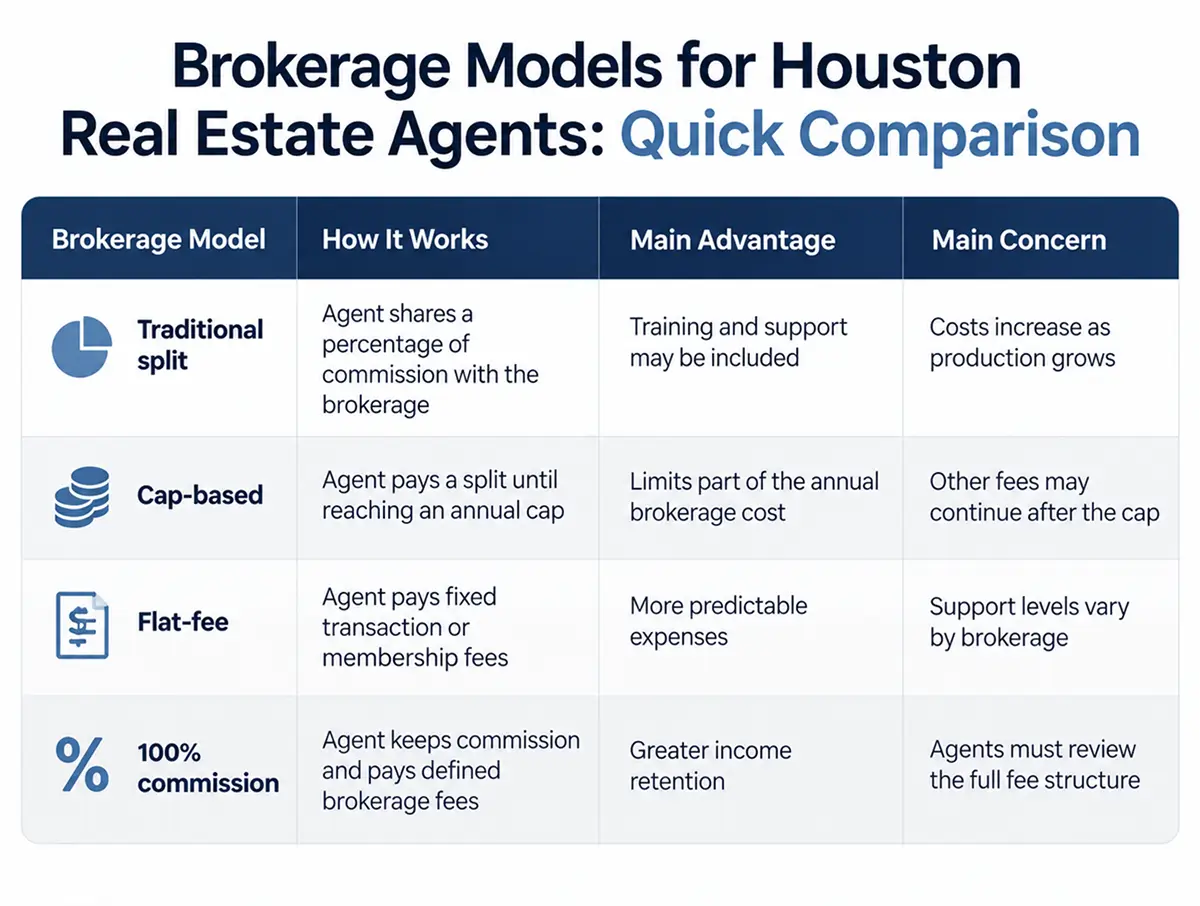
For top producers comparing brokerage options in Houston, there are four common models to consider: traditional split, cap-based, flat-fee, and 100% commission.
Let’s compare them.
What Top-Producing Houston Agents Need From a Brokerage
Newer agents often need intensive training, mentorship, and help building their first client base.
Experienced agents usually need something different.
For example, established Houston agents may already generate their own leads, pay for their own marketing, maintain a CRM, build referral networks, and manage an established client database.
As a result, their brokerage priorities often shift toward:
- Keeping more commission
- Predictable brokerage costs
- Responsive broker access
- Reliable compliance support
- Fast transaction processing
- Marketing freedom
- Personal branding flexibility
- Team-building opportunities
- Investment education
- Long-term business growth
Most importantly, a brokerage should provide enough value to justify what the agent pays.
As production increases, this becomes even more important.
A percentage that appears reasonable at lower production levels can become a major annual expense for a high-producing agent.
Therefore, top producers should calculate their total brokerage cost, not simply look at an advertised commission split.
If you want to identify those expenses first, read NB Elite Realty guide to how brokerage splits impact your commission.
No model is automatically right for every agent.
However, once production becomes consistent, the relationship between brokerage cost and brokerage value becomes much more important.
1. Traditional Split Brokerage Model
A traditional brokerage usually takes a percentage of each commission.
For example, an agent may operate under an 80/20 or 70/30 commission structure.
In return, the brokerage may provide training, technology, office resources, marketing tools, management, and other support.
For a new agent, that exchange may make sense.
However, the calculation changes for established producers.
Consider a Houston agent who generates $250,000 in gross commission income under an 80/20 structure.
At a straightforward 20% brokerage split, $50,000 would go to the brokerage before considering any additional charges.
At that point, the agent should ask:
Am I receiving $50,000 worth of value from my brokerage?
For someone who already generates leads, manages marketing, maintains client relationships, and handles an established pipeline, the answer may be very different than it was at the beginning of their career.
Consequently, traditional percentage splits can become increasingly expensive as production grows.
2. Cap-Based Brokerage Model
A cap-based brokerage attempts to limit part of that cost.
Under this model, the agent usually pays a percentage of commissions until reaching a predetermined annual cap.
After reaching it, the agent may keep a larger share of commissions for the remainder of the cap year.
Therefore, this model can be more attractive to productive agents than an unlimited split.
Still, the advertised cap does not always equal the total brokerage cost.
Additional charges may include:
- Transaction fees
- Technology fees
- Franchise fees
- Monthly charges
- Administrative costs
- E&O-related expenses
- Other required programs
For that reason, Houston agents should calculate what they would actually pay during a full year.
A lower cap does not necessarily mean a lower total cost.
3. Flat-Fee Brokerage Model
A flat-fee brokerage changes the relationship between production and brokerage expenses.
Instead of taking a percentage of every commission, the brokerage charges defined fees. Those costs may be based on transactions, membership, annual fees, or another predetermined structure.
As a result, expenses can become easier to predict.
Consider two Houston agents who close the same number of transactions.
One agent may specialize in higher-value properties and generate larger commissions. Under a traditional split, that agent could pay substantially more to the brokerage.
With a flat-fee structure, however, brokerage expenses may remain more consistent.
Therefore, more of the additional income can potentially stay inside the agent’s business.
That capital can then support:
- Digital advertising
- Lead generation
- Photography and video
- CRM technology
- Client events
- Assistants
- Transaction coordinators
- Team expansion
- Real estate investing
For top producers, predictable expenses can make business planning much easier.
4. 100% Commission Brokerage Model
A 100% commission real estate brokerage in Houston offers another approach.
Instead of surrendering a traditional percentage split, agents keep their commission at closing and pay the brokerage according to its stated fee structure.
Therefore, the cost of the brokerage does not necessarily rise at the same rate as the agent’s income.
This difference becomes increasingly important as production grows.
For example, an experienced agent who generates $300,000 in gross commission income may give up a substantial amount under a percentage-based structure.
With a 100% commission brokerage, that agent may be able to retain significantly more business capital.
However, “100% commission” should never be interpreted as “no costs.”
Agents should still review:
- Transaction fees
- Monthly or annual fees
- E&O-related expenses
- Technology costs
- Compliance services
- Broker support
- Other requirements
In other words, compare the complete model, not just the headline percentage.
Why Houston Agents Need a Brokerage Built for Flexibility
Houston is not one uniform real estate market.
An experienced agent may work with clients across central Houston, established neighborhoods, master-planned communities, fast-growing suburbs, luxury properties, new construction, relocation clients, or investor transactions.
Moreover, Houston-area opportunities can vary significantly from one community to another.
The Houston Association of REALTORS® regularly publishes Greater Houston housing statistics, market updates, affordability data, and reports on emerging communities. Its 2026 reporting continues to show differences in inventory, sales activity, affordability, and growth across the broader Houston area.
That matters for agents.
A luxury-focused producer may need extensive branding freedom.
Meanwhile, an investor-focused agent may value investment education and support for more complex transactions.
Similarly, a team leader may care about recruiting, scalability, and the ability to build a recognizable team brand.
Therefore, Houston agents benefit from a brokerage that allows their business model to evolve.
The brokerage should support the agent’s strategy rather than force every producer into the same system.
Top Producers Should Measure Net Income, Not Just Production
Real estate often celebrates sales volume.
However, high production does not automatically mean high profitability.
Gross commission income and net business income are not the same thing.
For example, two Houston agents could each generate $250,000 in gross commission income.
The first agent may lose a large portion through percentage splits and recurring brokerage charges.
The second may operate under a more predictable cost structure and retain considerably more.
Both agents produced the same amount.
Their businesses, however, may have very different profit margins.
Therefore, top producers should ask two questions:
How much am I producing?
And, more importantly:
How much am I actually keeping?
That second question can completely change how an experienced agent views a brokerage relationship.
Support and Compliance Still Matter
Keeping more commission is important. Nevertheless, experienced agents should not sacrifice professional support simply to reduce expenses.
Texas agents still operate within a regulated brokerage structure.
The Texas Real Estate Commission establishes rules related to broker responsibility and sponsored sales agents. Consequently, reliable broker oversight and compliance systems remain important regardless of the commission model.
Before choosing a brokerage, ask:
- Can I reach a broker when an issue arises?
- How quickly are questions answered?
- How are contracts reviewed?
- What compliance systems are available?
- Are brokerage fees transparent?
- What technology is included?
- Can I build my own brand?
- Can I grow a team?
- Does the brokerage understand investor transactions?
- Will the model still work as my production increases?
Ultimately, the lowest-cost brokerage is not automatically the best brokerage.
The stronger goal is:
Better economics + dependable support + flexibility + compliance.
Which Brokerage Model Protects a Top Producer’s Profitability?
The answer depends on the agent’s stage of business.
For instance, a new agent may receive enough value from intensive training to justify a traditional split.
A growing producer may prefer a cap-based structure because it places a limit on part of the annual brokerage contribution.
Meanwhile, an experienced agent who already generates consistent business may find a flat-fee or 100% commission structure more attractive.
The difference is straightforward.
With many traditional splits:
More production can mean paying more to the brokerage.
With a predictable flat-fee or 100% commission structure:
More production can allow more of the additional income to remain with the agent.
As a result, agents have more capital available to grow their businesses.
Experienced Houston Agents Should Think Like Business Owners
Successful agents increasingly operate like independent businesses.
They develop personal brands, generate leads, manage databases, invest in advertising, and maintain referral networks.
In addition, many experienced agents pay for their own photography, video, CRM systems, marketing campaigns, client events, and support staff.
As their businesses expand, some also hire assistants, marketers, transaction coordinators, or additional agents.
Because of this, the brokerage relationship should support growth rather than create unnecessary financial friction.
Once an agent reaches this stage, brokerage selection becomes part of a broader business strategy.
Therefore, experienced agents should regularly review whether the value they receive still matches the price they pay.
Why NB Elite Realty Makes Sense for Experienced Houston Agents
NB Elite Realty is built around a different idea:
Experienced agents should have the opportunity to keep more of what they earn while still having access to professional support.
NB Elite Realty currently states that agents receive 100% commission at closing. Its agent resources also include compliance review, broker access, educational materials, offices, technology resources, and investment-focused opportunities.
That combination matters because a strong brokerage model should do more than reduce a commission split.
It should help agents build stronger businesses.
With more control over their income, experienced agents can choose where to reinvest their capital.
For example, they may invest more in:
- Lead generation
- Personal branding
- Paid advertising
- Team development
- Technology
- Client acquisition
- Real estate investments
Additionally, NB Elite Realty places a strong emphasis on helping agents think beyond their next closing.
For agents interested in turning real estate income into long-term opportunities, read Investor-Friendly Brokerages: Why They Matter for Real Estate Agents.
The objective is simple:
Earn more. Keep more. Build wealth.
What Should Houston Agents Compare Before Switching?
Before making a brokerage change, review your last 12 months.
First, add up every brokerage-related expense:
- Commission splits
- Transaction fees
- Monthly fees
- Annual fees
- Technology fees
- Franchise charges
- Administrative expenses
- E&O-related costs
- Other required charges
Next, calculate the total.
Then compare that amount with the services you actually used.
Afterward, ask yourself:
If I closed the same transactions under another brokerage model, how much more could I have kept?
Also consider the support side of the equation.
Would the new brokerage give you access to the broker guidance, compliance resources, technology, branding freedom, and growth opportunities you need?
If your current brokerage no longer fits, NB Elite Realty also has a guide covering 10 signs it may be time to switch real estate broker.
Is Your Current Houston Brokerage Still Right for You?
The brokerage that helped you at the beginning of your career may not be the brokerage you need as a top producer.
Your production changes.
Your client base grows.
Your marketing becomes more sophisticated.
Your expenses increase.
Eventually, your goals may expand from closing more transactions to building a team, investing in real estate, and creating long-term wealth.
Therefore, your brokerage should evolve with your business.
If you already generate your own opportunities, manage an established pipeline, and invest heavily in your own growth, it is reasonable to ask whether a large commission split still makes sense.
Ready to Compare Your Brokerage With NB Elite Realty?
You worked hard to build your Houston real estate business.
Now make sure your brokerage model supports what you have built.
NB Elite Realty gives experienced agents a 100% commission structure, professional broker access, compliance support, business resources, and an investor-friendly environment designed around long-term growth.
Stop measuring your brokerage only by its name. Start measuring what it costs, what it provides, and how much of your success you get to keep.
If the numbers no longer work in your favor, it may be time to make a change.
See what your business could look like when you keep more of what you earn.

Or call (844) 444-NBER to learn more.