

A 100 commission brokerage can help real estate agents keep more of what they earn. However, the highest commission percentage does not always guarantee the best financial result.
Before switching brokerages, you need to compare the full cost. That includes transaction fees, membership charges, technology costs, insurance, support, and other expenses.
So, is a 100% commission model really worth it? For many productive agents, the answer is yes. Still, the right choice depends on your sales volume, business needs, and brokerage agreement.
What Is a 100 Commission Brokerage?
A 100% commission brokerage allows agents to keep the full commission they earn from a transaction. Instead of taking a percentage, the brokerage usually charges a flat fee.
Depending on the company and plan, agents may pay:
- A transaction fee after each closing
- A monthly or annual membership fee
- Errors and omissions insurance
- Technology or compliance fees
- Optional fees for marketing and lead-generation tools
This model differs from a traditional commission split. Under an 80/20 split, for example, the agent keeps 80% while the brokerage receives 20%.
With a 100% plan, the brokerage does not take a percentage of every commission. Therefore, the cost usually remains more predictable as the agent’s production grows.
Is a 100% Commission Brokerage Worth It?
For an agent with consistent production, a 100 commission brokerage can create significant annual savings.
Imagine that you earn a $15,000 gross commission from one closing. Under an 80/20 split, your brokerage would receive $3,000.
Now compare that with a flat transaction fee. Even after paying a few hundred dollars, you may still keep thousands more from the same closing.
As a result, you can reinvest the difference into:
- Digital advertising
- Professional photography
- Client events
- New technology
- Administrative support
- Real estate investments
- Your personal savings
However, commission is only one part of the decision. You should also consider support, tools, culture, training, and contract terms.
The best plan is the one that improves your total net income without limiting your ability to serve clients.
Common Misconceptions About 100% Commission Brokerages
The 100% model sounds simple. Still, several common misconceptions can cause confusion.
Misconception 1: Keeping 100% Means Paying Nothing
A brokerage must generate revenue to provide supervision, compliance, technology, and operational support.
Therefore, most 100% commission companies charge a flat transaction fee, membership fee, or another clearly defined cost.
Some companies may offer a zero transaction fee brokerage plan under specific conditions. However, you should always ask what qualifies a transaction for the zero-fee option.
Misconception 2: A 100% Brokerage Offers No Support
Commission structure and support quality are two separate issues.
Some low-cost brokerages provide limited help. Others offer broker access, training, technology, marketing resources, compliance guidance, and mentorship.
Before joining, ask how quickly the brokerage responds when a transaction becomes complicated. Strong support can protect both your deal and your reputation.
Misconception 3: This Model Is Only for Top-Producing Agents
Experienced agents often gain the most because they close more transactions. However, newer agents may also benefit if the brokerage provides the right training.
The key question is whether you can access the help you need without sacrificing a large percentage of your commission.
Misconception 4: The Highest Split Is Always the Best Deal
A high split looks attractive. Nevertheless, hidden fees can reduce the financial benefit.
For example, a brokerage may advertise a high commission percentage while charging for technology, leads, insurance, desk space, administration, and training.
That is why the best commission split brokerage should be chosen by net income, not by the advertised percentage alone.
Questions to Ask Before Joining
Before you sign a brokerage agreement, request a written explanation of every cost and service.
Start with these questions:
What Will I Pay Every Month or Year?
Ask about membership, desk, franchise, technology, insurance, and platform fees. Even small recurring costs can add up over time.
Is There a Fee for Every Closing?
Find out whether the transaction fee stays flat or increases with the sale price. Also, ask whether sales, leases, referrals, and team transactions have different fees.
Can I Qualify for Zero Transaction Fees?
If the company promotes a zero transaction fee brokerage plan, ask for the exact qualifications. Make sure the terms appear in writing.
What Support Is Included?
Ask about broker availability, contract review, compliance support, training, onboarding, and transaction management.
Additionally, find out whether support is available outside standard business hours.
Are Technology Tools Required?
Some brokerages include customer relationship management software, websites, lead platforms, and marketing tools. Others charge separately.
Ask which tools are required and which are optional.
What Happens to Pending Transactions If I Leave?
Review the company’s exit policy. You should understand how pending commissions, listings, client files, and fees will be handled.
Can I Build a Team?
If you plan to grow, ask about team structures, agent referrals, mentorship opportunities, and revenue-sharing programs.
Choosing a brokerage should support both your current production and your long-term goals.
How to Calculate Your Actual Take-Home Income
To compare brokerage plans fairly, calculate what remains after every brokerage-related expense.
Use this formula:
Actual take-home income = Gross commission income − commission split − transaction fees − recurring brokerage fees − other required costs
This calculation shows your earnings after brokerage expenses but before taxes and general business costs.
Step 1: Calculate Your Annual Gross Commission Income
Multiply your average gross commission per closing by the number of transactions you complete each year.
For example:
$15,000 average commission × 12 closings = $180,000 annual gross commission income
Step 2: Calculate the Cost of Your Current Brokerage
Suppose your brokerage uses an 80/20 split.
The brokerage would receive:
$180,000 × 20% = $36,000
If you also pay $1,200 in annual technology and administrative fees, your total brokerage cost becomes $37,200.
Your estimated take-home income before business expenses and taxes would be:
$180,000 − $37,200 = $142,800
Step 3: Compare It With a 100% Commission Plan
Now imagine a 100% brokerage charges a hypothetical $500 transaction fee and a $350 annual membership fee.
For 12 transactions, the cost would be:
12 × $500 = $6,000
After adding the membership fee, the total brokerage cost would be $6,350.
Your estimated take-home income would be:
$180,000 − $6,350 = $173,650
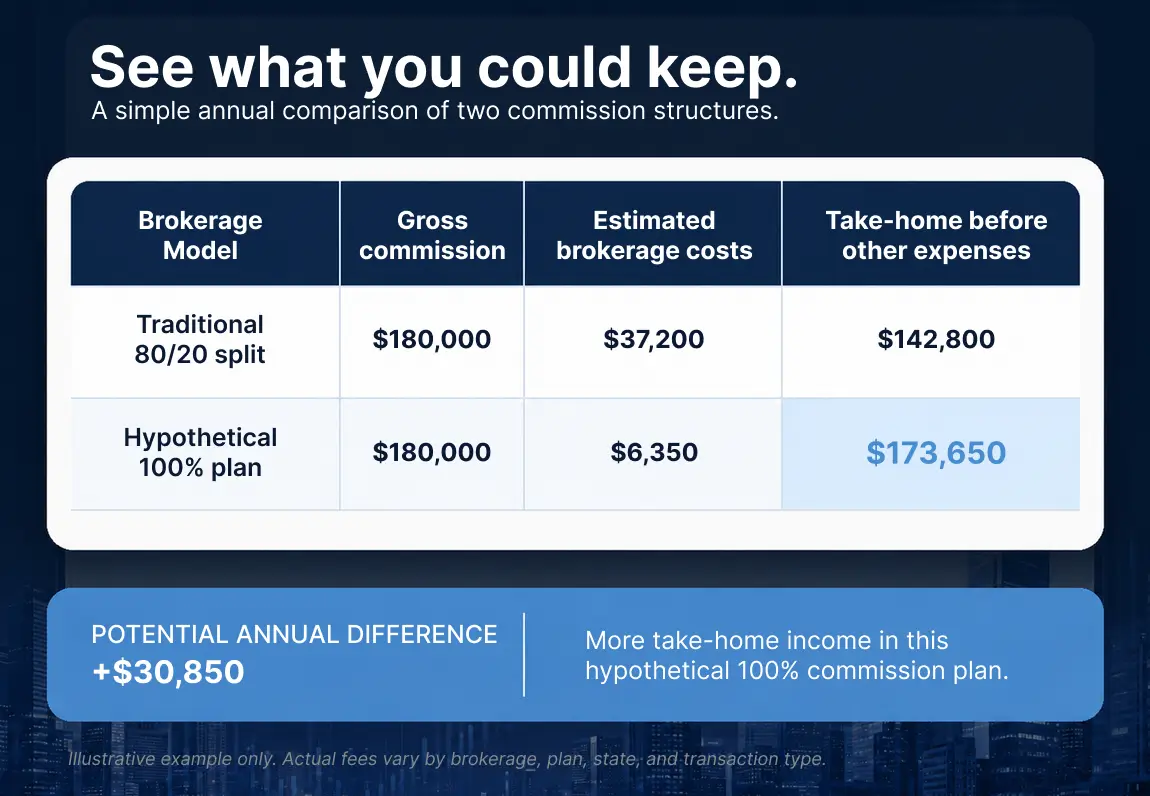
In this example, the agent keeps an additional $30,850 per year with the 100% plan.
These numbers are only an illustration. Actual fees vary by brokerage, state, transaction type, sale price, and selected plan.
Look Beyond the Commission Split
After comparing the numbers, consider the value you receive.
A less expensive brokerage may not be the right choice if it lacks essential compliance support. On the other hand, an expensive split may not make sense if you generate your own leads and manage your own marketing.
Evaluate the following areas:
- Broker and compliance support
- Training and mentorship
- Technology and transaction systems
- Marketing resources
- Company culture
- Team-building opportunities
- Investment education
- Geographic coverage
- Fee transparency
The best commission split brokerage should help you earn more while giving you the resources needed to protect and grow your business.
Who Benefits Most From a 100% Commission Model?
A 100 commission brokerage may be a strong fit if you:
- Close transactions consistently
- Generate your own business
- Want more control over your brand
- Pay thousands through percentage splits
- Plan to reinvest in marketing or real estate
- Want to build a team
- Prefer predictable brokerage expenses
However, agents who depend heavily on company-provided leads should compare the cost of generating those leads independently.
The model must fit the way you actually conduct business.
How NB Elite’s Commission Plans Work
NB Elite uses a 100% commission structure designed to help agents keep more of their earnings.
Instead of losing a percentage from each commission, agents pay low, transparent fees based on the applicable plan and transaction. Under certain conditions, zero transaction fee options may also be available.
Because plans can vary by state and transaction type, agents should review the current fee structure with an NB Elite representative before joining.
In addition to its commission model, NB Elite offers agents:
- Broker and compliance support
- Support beyond standard office hours
- Training and professional guidance
- Investment education and mentorship
- Technology and marketing resources
- Team-building and agent referral opportunities
- A supportive, collaborative company culture
- Coverage across Florida, Texas, New York, Illinois, and Tennessee
The goal is not only to help agents keep 100% commission. NB Elite also helps agents use those savings to strengthen their businesses and work toward long-term financial freedom.
Final Verdict: Is It Really Worth It?
A 100 commission brokerage can be worth it when the numbers, services, and culture match your needs.
However, do not make the decision based on one percentage. Calculate your true annual costs. Then compare the support, technology, training, and opportunities included with each plan.
If you consistently produce business and currently lose thousands through a traditional split, switching could significantly increase your take-home income.
Ready to Keep More of What You Earn?
You worked hard to earn every commission. Your brokerage model should help you protect it.
Speak with NB Elite to review the current commission plans available in your state. The team can help you compare fees, calculate your potential savings, and choose the right structure for your business.

Or call (844) 444-NBER to learn more.
Frequently Asked Questions