Choosing the right brokerage can shape far more than your commission structure. It can affect how quickly decisions get made, how supported you feel, and how much freedom you have to run your business your way.
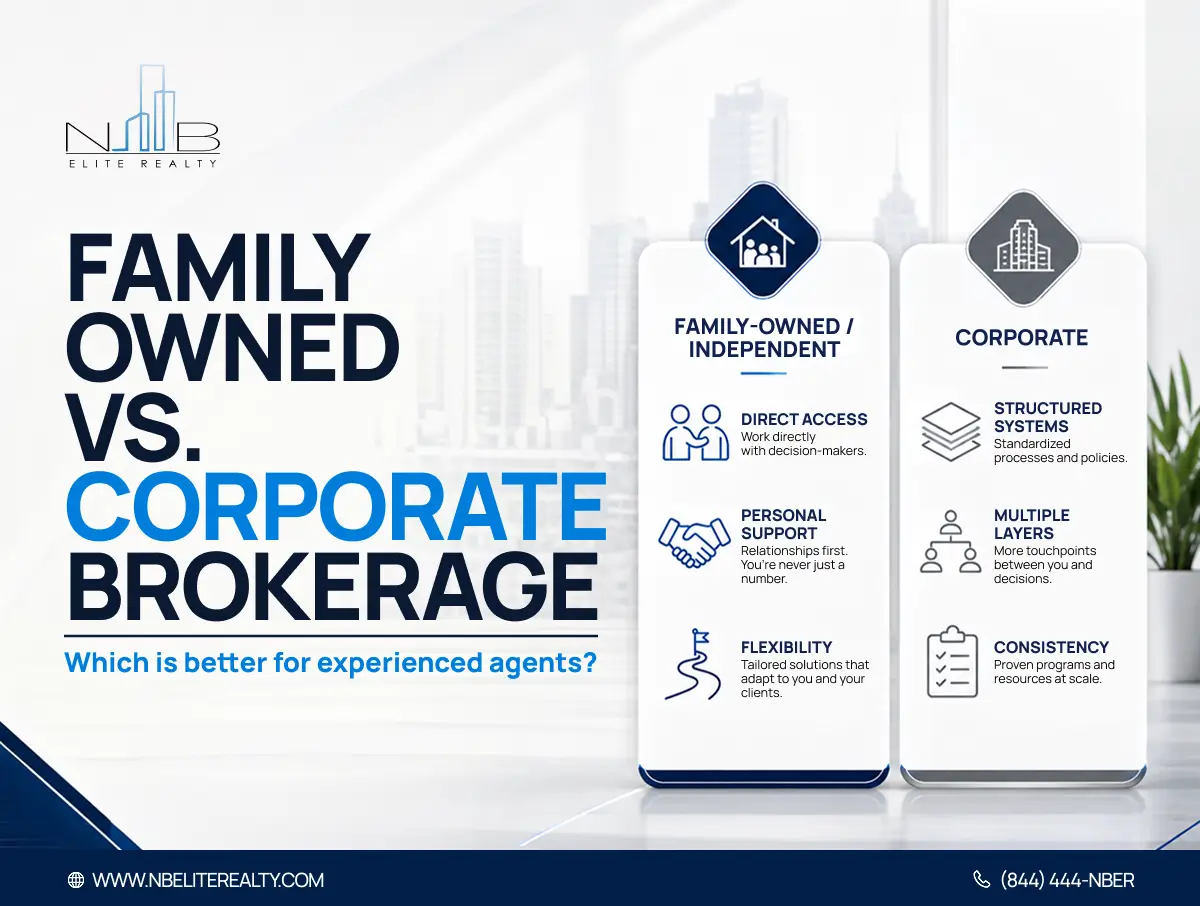
For experienced agents, the choice often comes down to two different models: a family owned real estate brokerage and a large corporate brokerage.
Both can offer valuable resources. However, the day-to-day experience can be very different.
So, which model is better?
The answer depends on what you value most as an agent.
What Is a Family Owned Real Estate Brokerage?
A family owned real estate brokerage is typically led by a smaller ownership or leadership group.
Because the organization is more focused, agents may have a more direct connection to the people making decisions.
These brokerages can also operate as an independent brokerage rather than as part of a large national corporate system. As a result, leadership may have more freedom to adjust policies, support agents differently, and respond to the needs of their market.
That structure can be especially appealing to experienced agents who already know how they want to build their business.
What Is a Corporate Brokerage?
A corporate brokerage is usually part of a larger organization with more standardized systems, policies, and procedures.
It may have multiple management layers, national branding, and company-wide processes.
For some agents, that structure provides familiarity and consistency. There may also be established systems for training, marketing, technology, and compliance.
On the other hand, larger organizations may have less room for individual exceptions. Decisions can also take longer when approval needs to move through several levels.
Ultimately, the better option depends on how much structure you want and how much autonomy you expect.
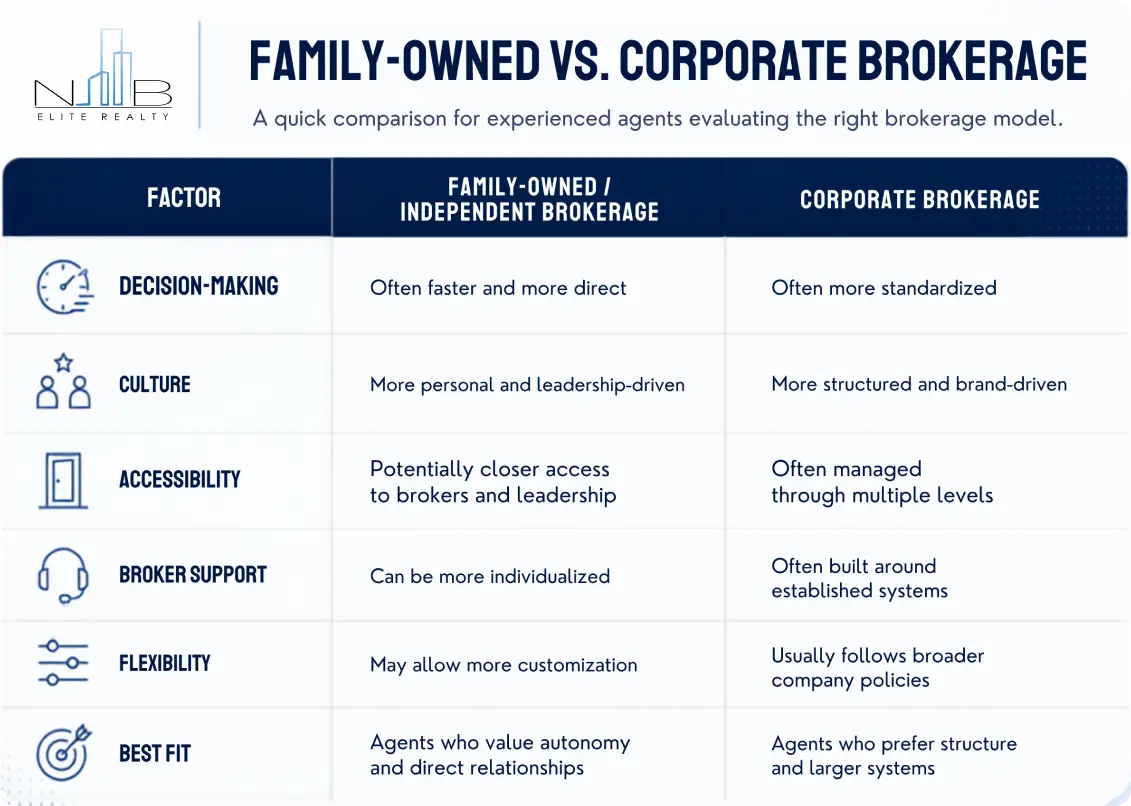
1. Decision-Making: Speed vs. Structure
Decision-making is one of the clearest differences between the two brokerage models.
At a family-owned or independent brokerage, there are often fewer layers between an agent and the person who can make a decision.
Therefore, questions may be answered faster. Policy discussions can also be more direct.
For an experienced agent, that matters.
You may not want to move through a long chain of approvals to solve a simple business issue.
A corporate brokerage, by contrast, may rely more heavily on standardized procedures. That approach can create consistency across offices and markets.
However, it can also make changes slower when a situation falls outside the normal process.
If you value fast answers and direct communication, a smaller brokerage structure may feel more efficient.
2. Culture: Personal Connection vs. Corporate Identity
Brokerage culture affects how agents experience the business every day.
In a family-owned brokerage, culture is often shaped directly by ownership and leadership.
Values, expectations, and communication can feel more personal because the people defining the culture may also be accessible to the team.
More importantly, agents may feel a stronger connection to the organization and the people behind it.
Corporate brokerages can offer a different experience.
Their culture may be more established and consistent across a large network. For agents who prefer recognizable systems and a broader company identity, that can be attractive.
Still, culture should never be judged by branding alone.
Before joining any brokerage, ask how leadership communicates, how agents are treated, and whether the environment supports the way you want to do business.
3. Accessibility: Can You Reach the People in Charge?
When business is moving quickly, access matters.
Imagine that you have a contract question, commission concern, or transaction that needs broker attention.
Who can you call?
More importantly, how quickly can you reach the right person?
At a smaller independent brokerage, agents may have more direct access to brokers and decision-makers.
Instead of moving through several departments, you may be able to speak directly with someone who has the authority to help.
In a larger corporate environment, support may be divided among managers, departments, regional teams, or support systems.
That structure can work well when the process is efficient. However, it may feel less personal.
For productive agents, accessibility is not simply a nice extra.
It can influence how smoothly business gets done.
4. Broker Support: What Does Support Actually Mean?
Nearly every brokerage says it offers support.
The more important question is:
What does that support actually look like?
Some agents need training, scripts, and step-by-step guidance.
Experienced agents may need something different.
They may value responsive broker access, transaction support, useful technology, business guidance, and help when a complicated situation appears.
A family owned real estate brokerage may have more flexibility to provide support based on the individual agent rather than following one fixed company process.
A corporate brokerage may offer a larger library of standardized resources.
That can also be valuable, especially for agents who prefer structured programs and established systems.
Therefore, before choosing either model, ask specific questions:
- Who handles contract questions?
- How quickly does the broker respond?
- What support is included?
- Which tools cost extra?
- Who helps when a transaction becomes complicated?
- How accessible is leadership?
The answers will tell you more than a recruiting presentation.
5. Flexibility: Can You Run Your Business Your Way?
Experienced agents often have established systems, marketing strategies, client processes, and business goals.
Because of that, flexibility can become one of the most important factors when choosing a brokerage.
An independent brokerage may have more room to adapt around the needs of productive agents.
For example, leadership may be able to make certain decisions without waiting for a broader national corporate policy to change.
Corporate brokerages, meanwhile, often prioritize consistency.
That can protect the brand and make operations easier across many offices. However, it may also create policies that do not perfectly fit every agent’s business model.
Neither approach is automatically better.
The question is whether the brokerage gives you the level of freedom you need without sacrificing the support you expect.
Which Brokerage Model Is Better for Experienced Agents?
There is no universal winner.
A brokerage is only better if its model supports the way you want to do business.
If you value a large organizational structure, standardized systems, and a familiar corporate environment, a corporate brokerage may be the right fit.
However, if you value direct communication, faster decision-making, accessibility, and flexibility, a family owned real estate brokerage deserves a closer look.
Experienced agents should also look beyond the logo.
Compare the actual broker access, technology, fees, support, flexibility, and overall business model each brokerage provides.
Most importantly, ask yourself one question:
Does this brokerage help me operate like the business owner I have become?
Questions to Ask Before Choosing a Brokerage
Before making a move, ask:
- How easy is it to reach the broker or leadership?
- Who makes decisions that affect agents?
- How quickly are agent concerns handled?
- What support is actually included?
- What fees or required expenses should I expect?
- How much control do I have over my marketing?
- How much freedom do I have to run my business?
- Does the brokerage adapt to experienced agents?
- What does the culture feel like after the recruiting conversation ends?
A strong brokerage should be able to answer these questions clearly.
The Right Brokerage Should Fit Your Business
The best brokerage is not necessarily the biggest one.
It is the brokerage that gives you the right combination of support, access, culture, economics, and flexibility.
For some agents, that may be a major corporate brand.
For others, an independent brokerage with accessible leadership and a more personal operating model may be a stronger fit.
If you are an experienced agent comparing brokerage models, look beyond the name on the sign.
Instead, focus on how the brokerage will affect your business after you join.
Ready for a brokerage model that better fits the way you do business?
Explore NB Elite Realty and see whether our approach is the right fit for your next move.

Or call (844) 444-NBER to learn more.